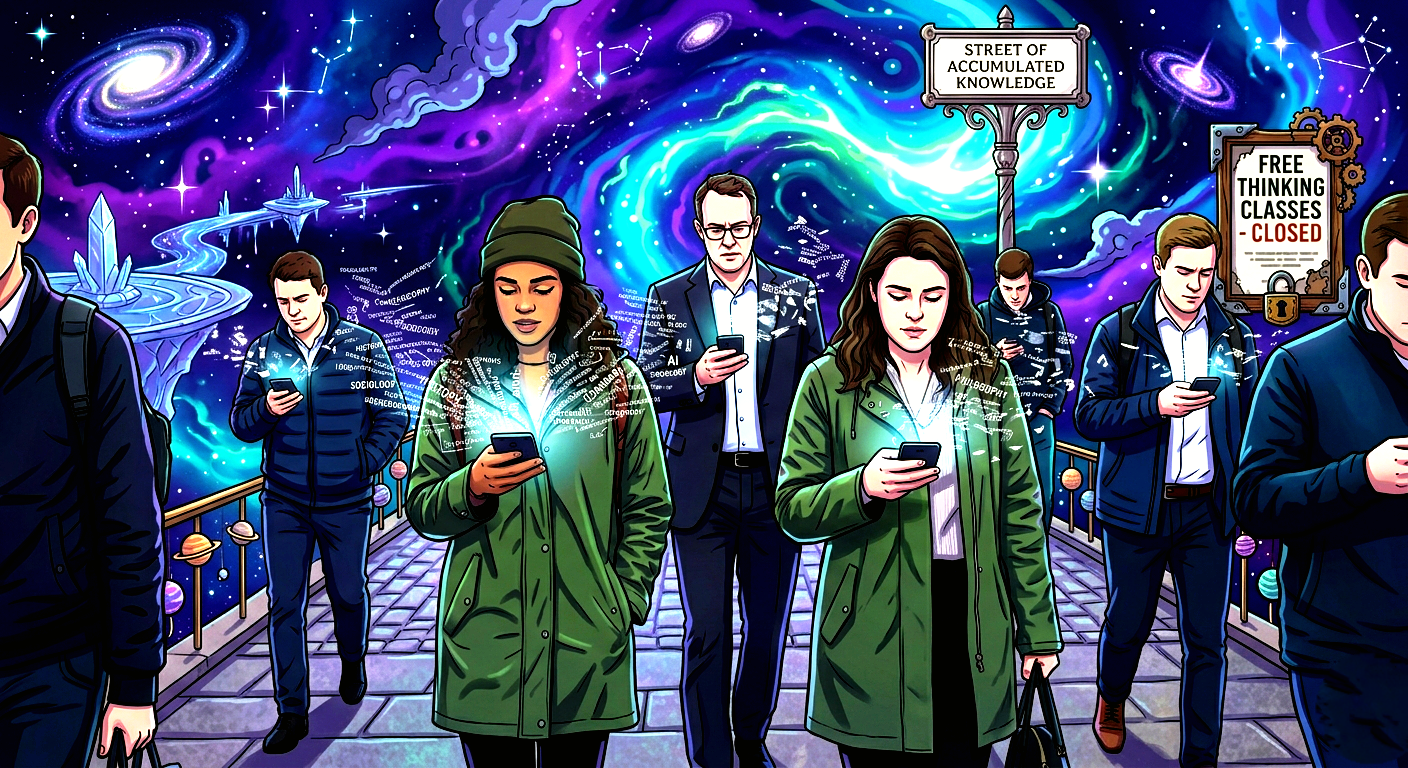


In the palm of almost every hand on Earth lies a rectangular slab of glass and silicon that grants instantaneous access to the sum total of human achievement. We carry the Library of Alexandria, the Louvre, the archives of NASA, and the collective legal codes of every nation in our pockets. Theoretically, we should be living in a second Renaissance—a golden age of polymaths and enlightened citizens.
Instead, we find ourselves in an era of unprecedented cognitive fragmentation. We have the knowledge, but we lack the architecture to house it. We are a civilization of world-class navigators who have forgotten how to read the stars.
The Grand Illusion of Accessibility
The fundamental mistake of the digital age was the assumption that access to information is equivalent to attainment of knowledge.
When you search for a complex scientific theory or a historical event on your phone, you aren’t “knowing” it; you are merely “retrieving” it. True knowledge requires a process of integration—linking new data to existing frameworks of understanding. Without this framework, information is just “digital noise.” It exists in a vacuum, easily forgotten and impossible to apply.
- Information: Disconnected facts (e.g., “The Boiling point of water is 100°C”).
- Knowledge: Understanding the relationship between those facts (e.g., how atmospheric pressure affects that boiling point).
- Wisdom: Knowing how to use that information to solve a problem or live a better life.
We have mastered the first, but we are losing our grip on the latter two.
The Death of Deep Thinking
The primary culprit is the design of the tools themselves. The smartphone is built for efficiency and distraction, not reflection. Our cognitive habits have been reshaped by the “infinite scroll” and the “notification ping,” favoring breadth over depth.
We have traded Deep Work—the ability to focus without distraction on a cognitively demanding task—for a shallow, frantic grazing. Because we know the information is always “there” (in the cloud), our brains have offloaded the responsibility of memory and synthesis. This is known as the Google Effect or digital amnesia: we are less likely to remember information that we believe can be easily found online.
The Educational Gap: We Teach “What,” Not “How”
Perhaps the most significant failure lies in our educational systems. For a century, schools were designed to turn students into “information repositories.” This made sense when books were scarce and information was hard to find.
In 2026, that model is obsolete. Yet, we still prioritize the memorization of facts over the mechanics of reasoning. We don’t train people in:
- Epistemology: How do we know what we know?
- Logic and Fallacies: How do we spot a flaw in an argument?
- Systems Thinking: How do disparate pieces of information interact within a larger whole?
- Critical Filter: How do we distinguish between high-quality evidence and sophisticated misinformation?
Without these “mental operating systems,” a person with a smartphone is like someone trying to build a skyscraper with a pile of bricks but no blueprint. They have the materials, but they will only ever produce a heap.
The Consequence: The Fragile Mind
When people cannot integrate information or reason through complexity, they become susceptible to “intellectual shortcuts.” This manifests as:
- Echo Chambers: It is easier to find information that confirms a bias than to reason through an opposing view.
- Outsourced Autonomy: We let algorithms decide what we should buy, who we should date, and what we should believe.
- Analysis Paralysis: Faced with an infinite stream of data, we lose the ability to make decisive, reasoned choices.
Reclaiming the Mind
To bridge the gap between “having” the world’s knowledge and “understanding” it, we must shift our focus from consumption to construction.
We need a radical return to the liberal arts—not as a collection of dusty subjects, but as a rigorous training in thinking. We must learn to put the phone down to think about what we just read on the phone. Integration requires silence, boredom, and the slow, often painful process of logical deduction.
The smartphone is the most powerful tool ever created, but a tool is only as effective as the hand that wields it. If we do not learn to reason, we will remain the most well-informed, yet most confused, generation in history.