
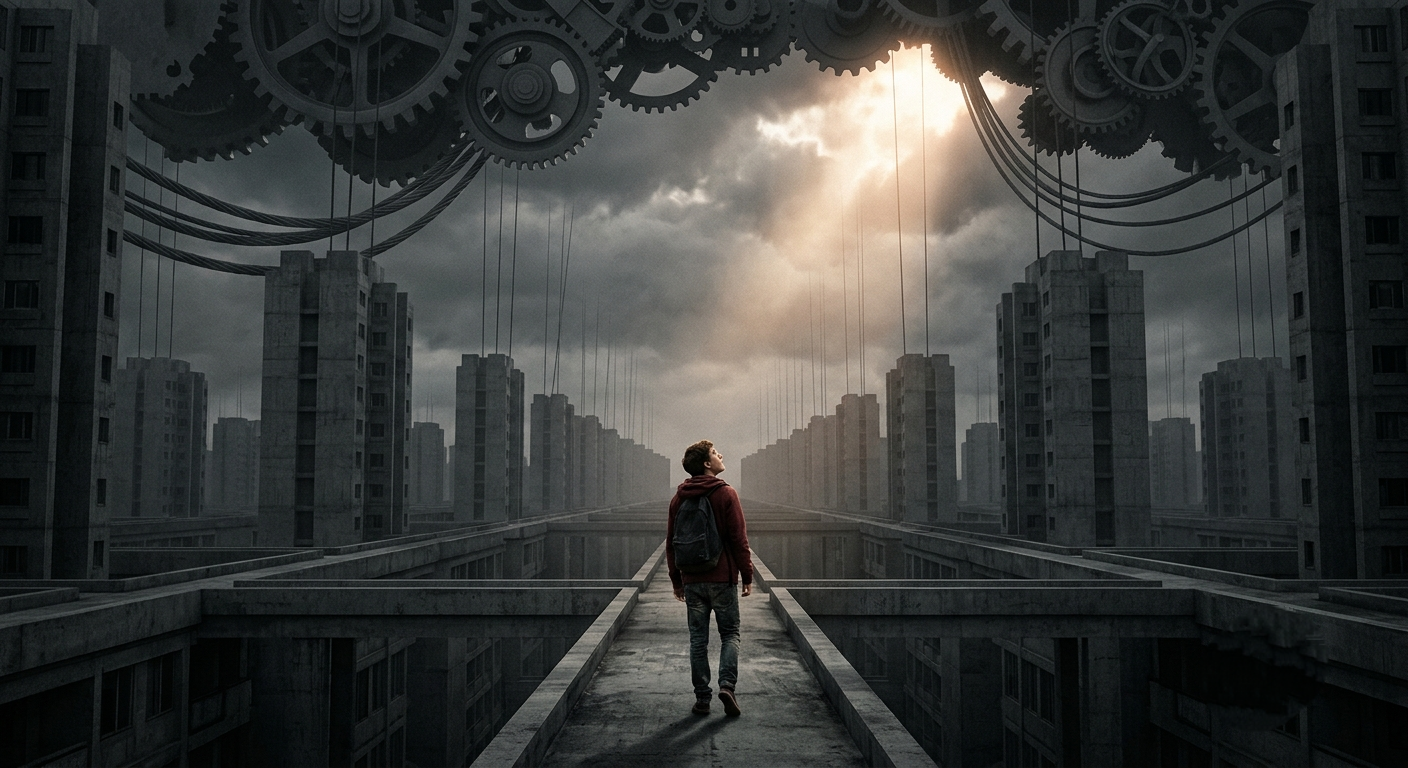


We often misuse the word “boring” to describe the texture of our daily lives. We apply it to the morning commute, the repetition of household chores, the predictable rhythm of a nine-to-five job, and the familiar geometry of our neighborhoods. But to call the everyday “boring” is a diagnosis error. Boredom implies a lack of stimuli, a vacuum of meaning, or a state of passivity where nothing is happening.
Everyday reality is rarely a vacuum. Instead, it is mundane—a word derived from the Latin mundanus, meaning “of the world.” The mundane is dense, heavy, and relentlessly present. When we strip away our superficial complaints about daily life, we uncover a deeper, more unsettling philosophical truth: Everyday reality feels mundane not because it lacks activity, but because it is profoundly uncontrollable.
The mundane is the arena where human agency clashes with the stubborn, unyielding machinery of existence. It is the realization that despite our grand ambitions, cosmic importance, and internal complexities, we are bound by physics, biology, bureaucracy, and time.
I. The Illusion of Control and the Shock of the Routine
From childhood, we are fed a narrative of radical autonomy. We are told we are the authors of our destiny, the captains of our souls. We build digital environments where we can curate our feeds, adjust our algorithms, and manifest realities at the touch of a button.
Then, we step outside.
The mundane reality immediately asserts its sovereignty. You cannot optimize the flow of traffic on the interstate. You cannot negotiate with the rain that spoils your walk. You cannot command your body to bypass the necessity of sleep, hunger, or aging.
The Paradox of the Mundane: The more we attempt to engineer a frictionless life through technology and planning, the more jarring the uncontrollable elements of reality become.
When you stand in a long line at a grocery store, the discomfort you feel is rarely true boredom. If you were truly bored, your mind would simply wander. The discomfort is actually a quiet, simmering frustration born of helplessness. You are a highly sophisticated conscious being, yet your entire existence has been bottlenecked by the physical reality of three people ahead of you debating coupons. The gridlock of the mundane is a sudden, sharp reminder that you do not own the world; you merely occupy a very small, highly restricted corner of it.
II. The Tyranny of the Unyielding Material World
We live in an era that worships the plastic, the digital, and the malleable. We are accustomed to realities that bend to our desires. If a video is slow, we skip it. If a game is hard, we change the difficulty.
The physical world, however, possesses what philosophers call “stubborn facticity.” It does not care about your schedule.
- Entropy as a Full-Time Job: The mundane is largely composed of fighting a losing battle against entropy. Dust gathers. Dishes dirty themselves. Clothes stain. Screws loosen. Roofs leak. None of these processes ask for your permission, and none of them care if you are tired.
- The Biological Tax: We are trapped in biological vessels that require constant, repetitive maintenance. We must chew, swallow, digest, excrete, wash, and rest. We must do this today, we must do it tomorrow, and we must do it until we die.
This unyielding maintenance is the bedrock of the mundane. It is uncontrollable because it is a tax levied on us by the mere act of being alive. You cannot opt out, you cannot automate it entirely, and you cannot delegate the living of your days to someone else. The repetition isn’t boring; it is an existential weight.
III. The Monotony of Collective Systems
Beyond the physical world lies the social and bureaucratic infrastructure we have built to survive en masse. To live in a modern society is to subject oneself to massive, invisible gears that turn independently of any single human will.
Consider the layout of a modern city. The streets are fixed, the train schedules are set, the zoning laws are codified. When you walk through a concrete landscape, you are walking through the crystallized decisions of people who died decades before you were born. You are forced to navigate their grid, their architecture, and their systemic failures.
[Your Individual Will]
       │
       ▼
 ┌───────────┐      ┌───────────┐      ┌───────────┐
 │ Traffic   │ ───> │ Bureaucracy│ ───> │ Economic  │
 │ Grids     │      │ & Laws    │      │ Markets   │
 └───────────┘      └───────────┘      └───────────┘
       │
       ▼
[The Mundane Reality] (Where individual agency is absorbed)
This systemic rigidity creates a profound sense of determinism. You must show up at a certain time, pay a certain tax, fill out a specific form, and follow a particular protocol. The mundane is the feeling of being a single cog inside an unimaginably vast machine. It is not boring—it is intimidatingly, claustrophobically vast. It is the realization that your unique, fiery consciousness is being filtered through a standardized, gray interface.
IV. The Sublime Dread of the Present Moment
Boredom is a forward-looking condition; it is the desire for the next thing to happen. The mundane, conversely, forces you into an absolute, unvarnished collision with the present thing.
When there are no crises to solve, no dramas to navigate, and no immediate threats to our survival, we are left alone with the sheer fact of existence. This is what the French existentialists called Nausea. It is the realization that existence is independent of meaning. A plastic chair, a stained carpet, a overcast sky—these things simply are. They do not exist to entertain us, validate us, or give us a sense of purpose.
In these quiet, uncontrollable stretches of everyday life, we encounter the terrifying neutrality of the universe. The clock ticks at exactly the same speed whether you are falling in love or waiting for toast. This indifference is what makes the mundane so heavy. It refuses to warp itself around our emotional needs.
V. Reclaiming the Mundane: From Hostility to Hospitality
If the mundane is defined by its uncontrollability, how do we survive it without falling into despair or chronic disassociation? The answer lies not in trying to conquer the everyday, but in changing our terms of surrender.
- Acknowledge the Scale: Recognize that the stubbornness of reality is not a personal conspiracy against you. The traffic jam is not an insult; it is a mathematical consequence of population density.
- Find the Micro-Agency: While you cannot control the existence of the mundane, you can control the quality of your attention within it. The poet Mary Oliver famously wrote that “attention is the beginning of devotion.” When we stop fighting the fact that we are washing dishes and actually look at the light refracting through a soap bubble, the mundane transforms. It ceases to be a prison of helplessness and becomes a gallery of unglamorous wonders.
- Embrace the Safety of the Ordinary: The uncontrollable nature of the mundane is also its saving grace. The fact that the sun rises, gravity holds, and the mundane world continues to function regardless of our internal chaos provides a vital anchor. When our personal lives fracture through grief, heartbreak, or trauma, the stubborn, indifferent continuity of the mundane world is often the very thing that keeps us grounded.
The Ultimate Subversion
Everyday reality is a wild, untamed beast masquerading as a boring routine. It refuses to be curated, it declines to be optimized, and it completely ignores our demands for constant novelty. It is a masterpiece of unyielding laws and repetitive cycles.
To call it boring is to look at an ocean and complain that it is only water. Once we accept that the mundane is a testament to a world that exists completely outside of our control, we can finally stop fighting it. We can step into the repeating pattern, look up at the gray sky, and find a strange, quiet freedom in simply being a part of the machinery.

Leave a Reply