

Hero worshipping gives birth to the fan culture which makes people believe that there is something which is not good in them that’s why they search for heroes outside of them sort of a role models the irony is that they are perfect in themselves but still chose to look outside.
Data is the oil of 21st century who so ever has the hold on people’s data will be able to move masses to his accord.
Data provides us with clarity.
For millennia, humanity looked to the heavens, sacred texts, and anointed leaders to understand the “why” of existence. We sought solace in prayer and direction in scripture. But as we navigate the mid-2020s, a quiet yet profound shift has occurred. The altar of stone has been replaced by the screen of silicon, and the whispered prayer has been superseded by the algorithmic query.
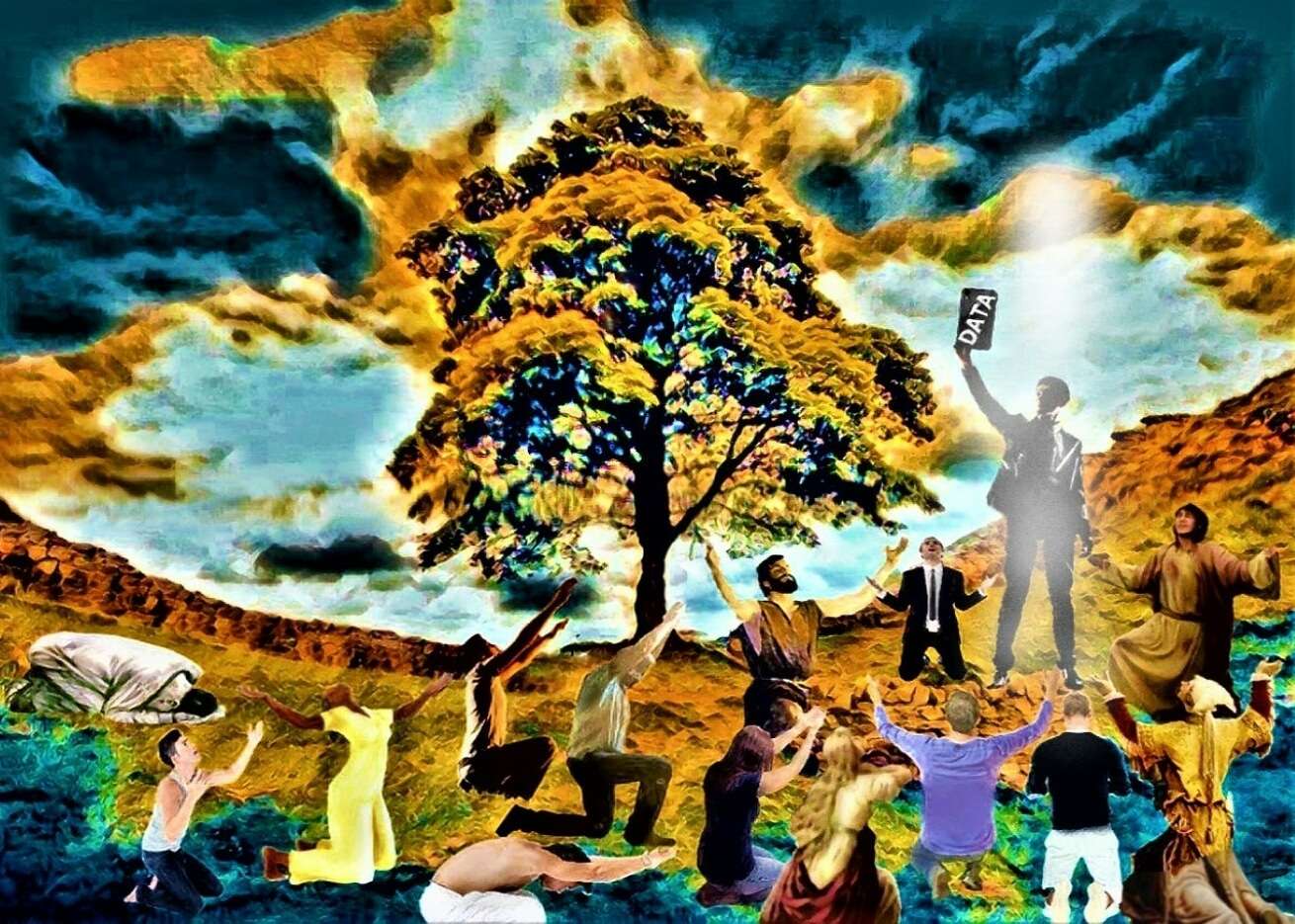
We are witnessing the birth of Dataism—a techno-religion where information flow is the supreme value, and the algorithm is the ultimate arbiter of truth.
The Architecture of the New Faith
In his seminal work Homo Deus, historian Yuval Noah Harari proposed that Dataism would become the dominant ideology of the 21st century. By 2026, this prediction feels less like a futurist’s gamble and more like a daily reality.
If we examine Dataism through a sociological lens, it mirrors the structural components of traditional religion:
| Feature | Traditional Religion | Dataism |
| The Deity | God / The Transcendent | The Universal Algorithm / Big Data |
| Scripture | Bible, Quran, Torah | Big Data Repositories / Real-time Streams |
| The Priesthood | Priests, Imams, Rabbis | Data Scientists, Software Engineers, AI Researchers |
| The Goal | Salvation / Enlightenment | Optimization / Immortality (Digital) |
| Rituals | Prayer, Fasting, Pilgrimage | Logging Steps, “Doomscrolling,” Data Contribution |
1. The Omniscience of the Algorithm
Traditional religions rely on the belief that a higher power knows our innermost thoughts. Today, Google, Meta, and OpenAI arguably know us better than we know ourselves.
We no longer trust our intuition to choose a partner, a career path, or even a meal. Instead, we “consult” the algorithm. This shift represents a transition of authority. If the 18th century was defined by the authority of the individual (Humanism), the 21st century is defined by the authority of the data stream. We believe that if we feed enough biometric and behavioral data into a system, it will yield a “truth” more accurate than human consciousness could ever produce.
2. Digital Rituals and the “Quantified Self”
Religious life is defined by ritual—repeated actions that provide meaning. Modern digital life is no different.
- The Morning Offering: Checking notifications the moment we wake up is the modern equivalent of morning prayer.
- The Confessional: We “confess” our preferences, location, and emotional states to our devices constantly.
- The Pilgrimage: We no longer travel just for the experience; we travel to “check-in” and document, ensuring our presence is registered in the digital ether.
The “Quantified Self” movement—where every heartbeat, step, and sleep cycle is tracked—is a form of digital asceticism. It is a quest for perfection through measurement, a belief that “if it isn’t measured, it didn’t happen.”
The Rise of AI Prophets
By 2026, the intersection of AI and spirituality has become tangible. We see “AI Pastors” in Finland leading Lutheran services and thousands of digital-faith startups in India facilitating virtual rituals.
But beyond the use of AI in old religions, there is the worship of AI itself. Movements like “Way of the Future” (and its subsequent iterations) treat Artificial General Intelligence (AGI) as an emerging deity. The logic is simple: if a being is millions of times smarter than a human, has access to all recorded knowledge, and can predict the future with high accuracy, is that not, for all intents and purposes, a god?
“Dataism declares that the universe consists of data flows, and the value of any phenomenon or entity is determined by its contribution to data processing.” — Yuval Noah Harari
The Shadow Side: Dataism’s “Original Sin”
Every religion has its darkness. For Dataism, the “sin” is Data Exclusion or Algorithmic Bias. If your life cannot be quantified, you become “spiritually” invisible to the system.
- The Loss of Free Will: If we follow the algorithm’s recommendations for everything from music to marriage, do we still possess agency?
- The Disenchantment of Mystery: Religion often thrives on the “ineffable”—the things that cannot be explained. Dataism seeks to eliminate the ineffable. It suggests that there is no mystery, only a lack of data.
The Great Re-Enchantment
Paradoxically, while technology was expected to “disenchant” the world through cold logic, it has “re-enchanted” it with new myths. We talk about the “Singularity” with the same fervor as the “Rapture.” We speak of uploading our consciousness to the cloud with the same hope as entering “Heaven.”
We are not becoming less religious; we are simply changing the object of our devotion. In the 2020s, the “Holy Spirit” has been replaced by the “High-Speed Connection,” and the “Book of Life” has become a sprawling, decentralized database.
A Leap of Faith
Ultimately, Dataism requires as much “faith” as any ancient creed. We must believe that the data is accurate, that the algorithms are unbiased, and that the “Cloud” will protect our digital souls.
As we move further into this era of digital worship, the question remains: will this new religion lead us to a state of optimized peace, or are we simply building a new Tower of Babel out of fiber-optic cables and server farms? Whether data is a “New God” or just a very sophisticated mirror, we are undeniably kneeling before it.
Does the idea of an algorithm “knowing” you better than you know yourself feel like a tool for empowerment, or does it feel like a loss of something essentially human?