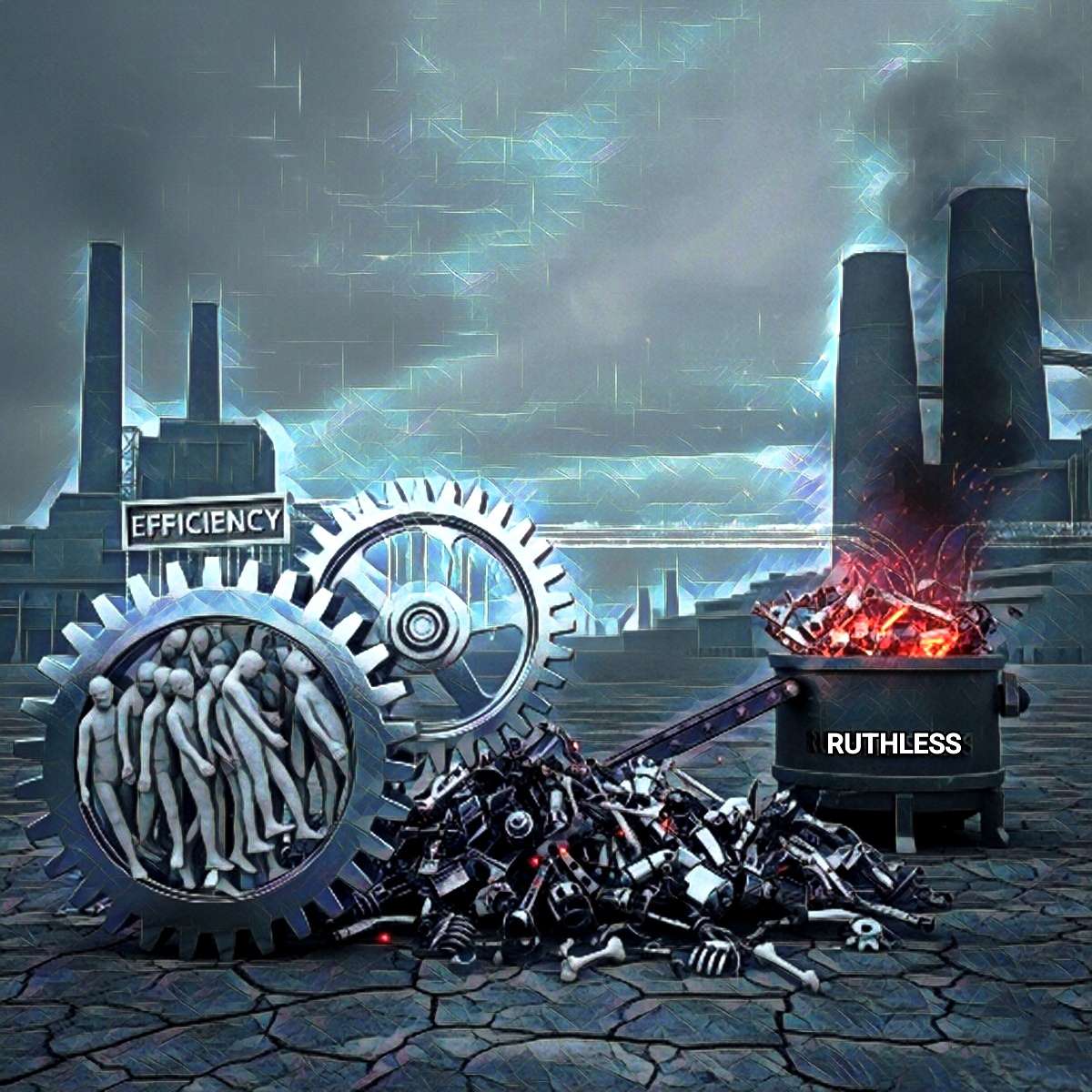


In the 21st century, the word “efficiency” has transitioned from a modest engineering goal into a supreme cultural and economic deity. We worship at the altar of the “optimized” life, the “streamlined” business, and the “frictionless” transaction. From algorithmic hiring to just-in-time logistics, the world is becoming demonstrably more efficient. However, this progress masks a growing shadow: as we strip away the “waste” of human friction, we also strip away the padding of human mercy. The more efficient the world becomes, the more ruthless it inevitably feels.
The Engineering of Ruthlessness
At its core, efficiency is about the ratio of output to input. To be efficient is to achieve a goal using the minimum amount of resources—time, money, or energy. In a vacuum, this is a moral good. It allows for the conservation of resources and the expansion of possibilities. But when applied to human systems, the definition of “waste” becomes dangerously broad.
In an efficient system, empathy is often categorized as “friction.” A manager taking an hour to console a grieving employee is an inefficient use of corporate time. A doctor spending twenty minutes listening to a patient’s life story, rather than just diagnosing their symptoms, is an inefficiency in the healthcare billing cycle. When systems are designed to maximize throughput, the qualities that make us human—vulnerability, spontaneity, and emotional complexity—are the first “inefficiencies” to be pruned.
The Algorithmic Gaze
The rise of Big Data and Artificial Intelligence has accelerated this process to a terminal velocity. Algorithms do not possess a “moral compass”; they possess “optimization functions.”
Consider the modern hiring process. In an effort to be more efficient, companies use automated resume filters. These systems are ruthlessly effective at narrowing down 10,000 applicants to 10 in seconds. However, they lack the capacity for nuance. They cannot see the potential in a candidate with a non-traditional background or the resilience of someone who took a gap year to care for a sick relative. To the algorithm, these are simply data gaps—errors to be discarded.
This “algorithmic dehumanization” extends to every facet of life:
- Surveillance Capitalism: Platforms optimize for “engagement,” which is often a polite word for “addiction.” They ruthlessly exploit human psychology to keep users scrolling, regardless of the impact on mental health.
- Precision Logistics: Delivery drivers and warehouse workers are tracked by software that calculates every second of their movements. In this hyper-efficient environment, a bathroom break becomes a statistical deviation that threatens a performance metric.
- Credit and Insurance: Decisions on who receives a loan or affordable healthcare are increasingly made by black-box models that prioritize risk-reduction over individual circumstances.
The Death of the “Buffer”
In a less efficient world, there was “slack” in the system. This slack functioned as a social and emotional safety net. If you were having a bad week, the local shopkeeper might let you pay later, or your boss might overlook a missed deadline because they knew your personal situation.
Today, that slack has been engineered out. We have moved toward “Just-in-Time” everything. While this reduces inventory costs and speeds up delivery, it leaves zero margin for error. When there is no buffer, any mistake—be it a late train, a sick child, or a mental health lapse—leads to immediate and ruthless consequences. The system is so finely tuned that it has become brittle; it cannot bend, so it breaks the people within it.
“Hyper-efficiency demands constant mental and physical energy. Eventually, this relentless pressure leads to burnout, characterized by emotional exhaustion and cynicism.”
The Competition Trap
Efficiency also drives a “race to the bottom” in terms of human welfare. In a globalized market, if one company becomes more efficient by cutting employee benefits or automating its workforce, its competitors must follow suit to survive. This creates a ruthless environment where the “most efficient” actor sets the standard, and that standard is often one that treats humans as interchangeable biological assets.
This competitiveness has moved from the corporate level to the individual. We are now encouraged to “optimize” our sleep, our diets, and our social lives. We have become the CEOs of our own lives, viewing our friends as “networking opportunities” and our hobbies as “side hustles.” When we treat ourselves as machines to be optimized, we become ruthless toward our own needs for rest and reflection.
Reclaiming the Inefficient
To build a world that is not just efficient but also livable, we must recognize that some of the best parts of life are fundamentally “wasteful.” Conversation without an agenda, art without a commercial purpose, and compassion that ignores the “bottom line” are the very things that make life worth living.
The challenge of the coming decades will be to decide where efficiency belongs (in our power grids and supply chains) and where it must be strictly forbidden (in our relationships, our justice systems, and our sense of self-worth). If we do not intentionally design “friction” back into our social structures, we will find ourselves living in a perfectly optimized machine that has no room for the people who built it.