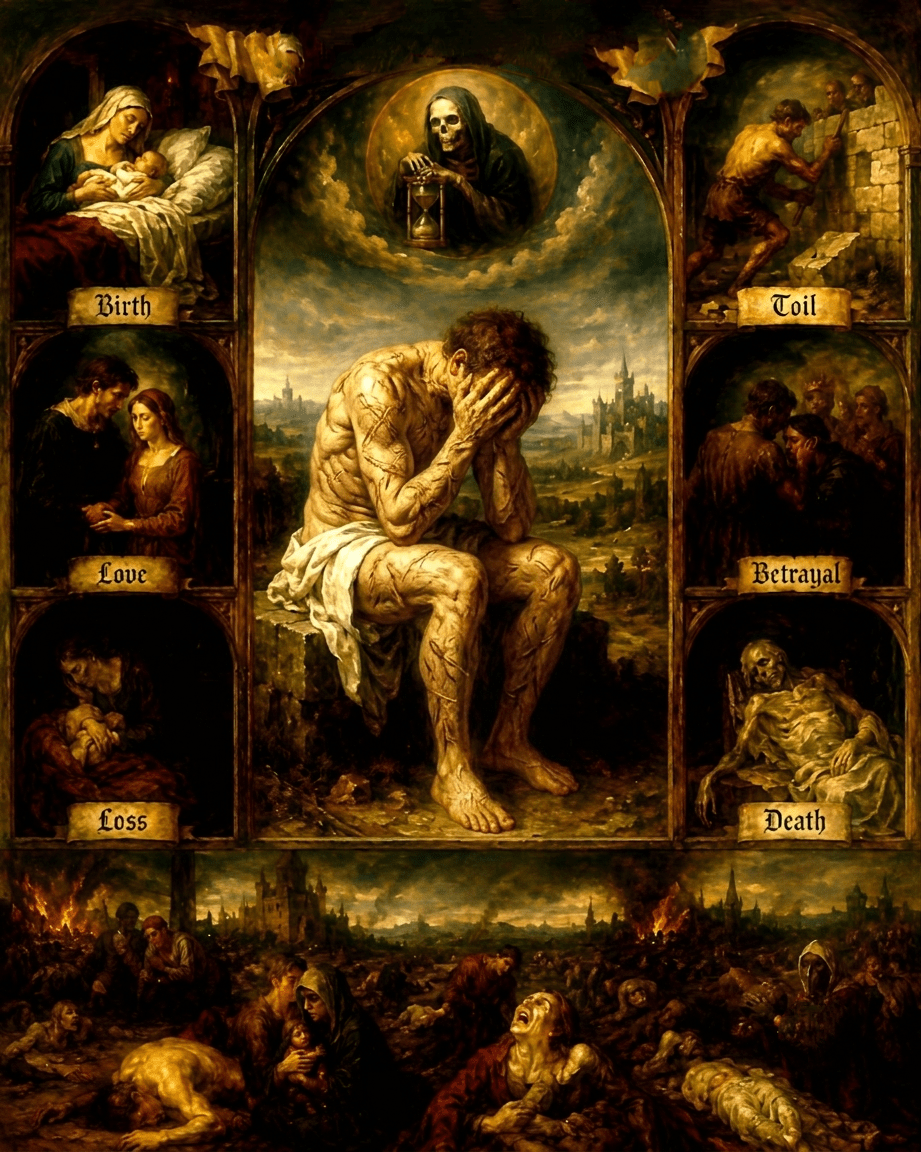
A dark, allegorical painting in a dramatic, classical style depicting the suffering and stages of the human condition.

In the center, a muscular, heavily scarred man sits hunched forward on a stone block, burying his face in his hands in an expression of deep grief or despair. Above him, a skeletal figure of Death emerges from a dark cloud, holding an hourglass.

Flanking the central figure on either side are six smaller, arched panels, each labeled with a banner:

* **Left column:** "Birth" (a mother holding a newborn), "Love" (a couple holding hands), and "Loss" (a weeping figure hunched over a body).
* **Right column:** "Toil" (a man laboring with heavy stones), "Betrayal" (figures whispering in secret), and "Death" (a shrouded corpse).

The background behind the central figure shows a distant, peaceful castle landscape under a cloudy sky. In stark contrast, the entire bottom section of the artwork depicts a chaotic, hellish landscape of war, plague, or apocalypse, filled with weeping people, scattered bodies, burning buildings, and figures suffering amidst ruins.

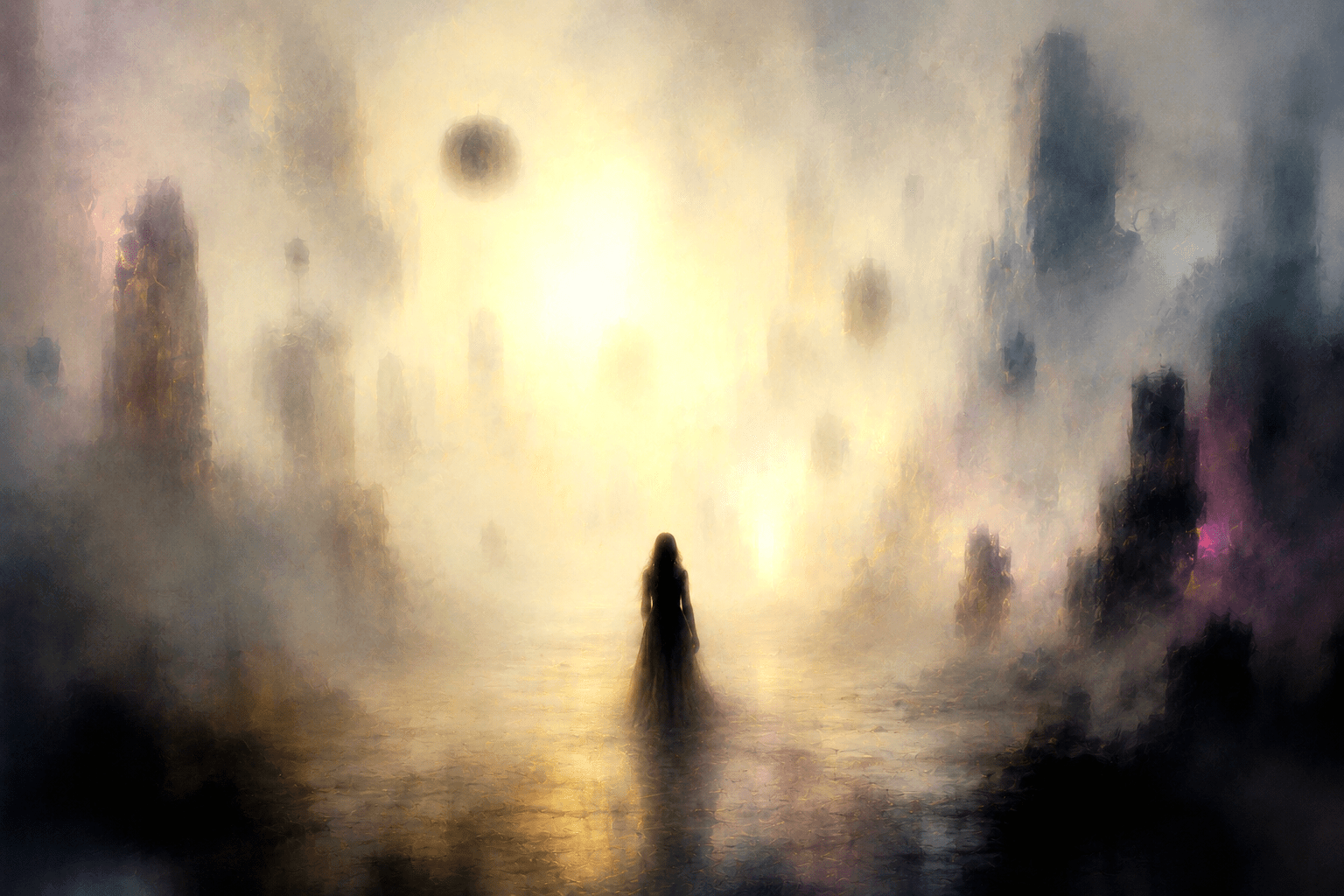
To me, it’s the condition of being suspended between two worlds and being unable to fully enter into either. We can’t reach the upper realm (that belongs to the gods) but we can’t forget it either; we can’t escape intimations and half-memories of… some prior sojourn, before birth perhaps, among the immortals or the stars.

Our lot instead is to dwell in the lower realm, the sphere of the temporal and the material—the time bound dimension of instincts and animal passions, of hate and desire, aspiration and fear. We’re called to the upper realm (and it is calling to us) but we’re having a pretty good time (sometimes) down here in the sphere of the senses.
Discover more from CREZONSTZ

Subscribe to get the latest posts sent to your email.

Leave a Reply

Your email address will not be published. Required fields are marked *

Trending