
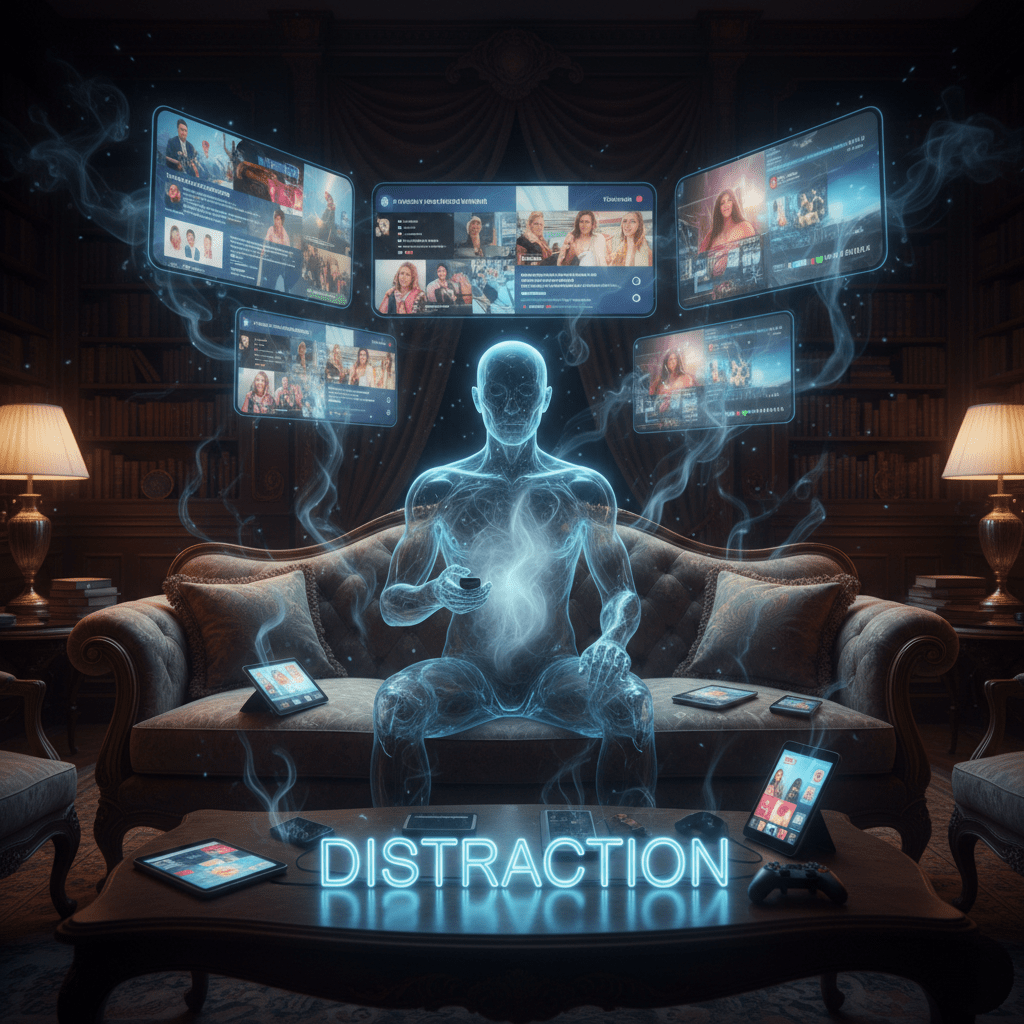


In the ceaseless, hyper-connected rhythm of modern life, a quiet epidemic festers beneath the surface of our digital facades and busy schedules: the creeping sense of superficial emptiness. This isn’t the profound, existential angst pondered by philosophers in solitude; rather, it is a pervasive, low-grade hollowness—a lack of substantive, intrinsic value in the fabric of our daily existence. And perhaps the most telling symptom, the most visible manifestation of this internal vacuum, is our insatiable, often desperate, desire for distraction.
🧐 The Diagnosis: What is Superficial Emptiness?
Superficial emptiness can be defined as a state where an individual’s life, despite potentially being filled with activity, material possessions, and social connections, lacks depth, meaning, and authentic self-connection. It is an existence largely defined by external validation, fleeting pleasure, and the accumulation of markers of success that do not resonate with the core self.
The Components of the Void:
- Lack of Internal Validation: Our self-worth becomes wholly dependent on external metrics: likes, followers, titles, salaries, or the envy of peers. When the external gaze shifts, the internal sense of self collapses.
- The Cult of Performance: We are constantly “performing” our lives—curating an ideal image for social media, feigning expertise, or adopting lifestyles purely for optics. This constant pretense drains energy and leaves little room for genuine self-discovery.
- Shallow Relationships: Social connections become transactional or based on shared, superficial interests, failing to meet the human need for deep, vulnerable, and meaningful intimacy. We have many “friends” but often feel profoundly alone.
- Consumption as Identity: We are encouraged to buy our way into a personality. Our hobbies, opinions, and even moral stances are often dictated by what we consume—be it clothing, media, or political commentary—rather than being organically grown from within.
📱 The Symptom: The Addiction to Distraction
If life is a vessel, superficial emptiness is the hole that leaks meaning. The desire for distraction is the desperate, continuous effort to fill that vessel with anything—anything at all—to avoid looking at the hole or feeling the chill of the void.
The Modern Drug: Digital Escapism
The current technological landscape is perfectly engineered to cater to this need. Smart devices have become sophisticated delivery systems for constant, low-effort stimulation.
- The Endless Scroll: Social media feeds and video platforms are designed to exploit our psychological vulnerabilities, offering a continuous stream of novelty. This perpetual novelty acts as a mild anesthetic, keeping the mind occupied just enough to prevent reflection.
- Gaming and Binge-Watching: While offering legitimate forms of enjoyment, their compulsive use is often a flight from reality. Immersing oneself in a fictional narrative or a virtual world provides a temporary, manufactured sense of purpose and achievement that real life seems to withhold.
- Hyper-Productivity as Distraction: Even virtuous activities can be co-opted. Overworking, relentless self-improvement routines, or obsessive schedule-filling can be a way of distracting oneself from larger, more difficult existential questions. A perpetually “busy” person often has the least time for introspection.
“Our need for distraction is the most persuasive evidence that we are not living a life that is inherently engaging to us. We seek to escape because the reality we’ve constructed is unsatisfactory.”
Why Distraction is a Temporary Fix
The core problem with distraction is that it is fundamentally an avoidance mechanism. It addresses the discomfort without addressing the cause.
- It Hinders Introspection: True personal growth requires periods of quiet contemplation to process emotions, evaluate values, and make conscious life choices. Distraction ensures we are never bored, but boredom is often the precursor to creativity and profound thought.
- It Perpetuates Shallow Living: By choosing easy, external stimuli, we de-prioritize the difficult work of developing internal resources—such as emotional resilience, intellectual curiosity about deep subjects, or mastery of a challenging skill.
- The Hedonic Treadmill: The fleeting pleasure of distraction offers diminishing returns. The “high” of a new notification or a finished season of a show quickly fades, necessitating an immediate search for the next hit, locking the individual onto a treadmill of continuous, unsatisfying pursuit.
💡 The Consequences: A Society of Performers
When superficial emptiness becomes widespread, the societal consequences are profound.
A. The Crisis of Authenticity
- Political Polarization: When people lack an authentic internal compass, they often latch onto the most visible, tribal, or performative identities offered by politics or culture wars. Passionate belief can become another form of distraction, substituting genuine conviction with a ready-made, externally validated group identity.
- Erosion of Attention Spans: Our collective ability to focus on complex, long-term issues—from climate change to deep research—is compromised. We favor bite-sized content, sensationalism, and quick summaries, rendering us ill-equipped to tackle problems requiring sustained, deep thought.
B. The Pervasiveness of Anxiety
The constant effort required to maintain a performative, distracted life leads to chronic stress. The individual is not truly present in their life; they are always either performing the next moment or escaping the current one. This state of constant avoidance translates directly into anxiety, a feeling of unease that something is fundamentally wrong, an intuition that is ruthlessly suppressed by the next ping or scroll.
🌱 Finding the Core: A Path Towards Substance
The antidote to superficial emptiness is not the elimination of all pleasure or technology, but the intentional cultivation of depth and meaning.
- Embrace Boredom and Solitude: Schedule periods of “digital fasting” and unstructured time. Allow the mind to wander. The discomfort of boredom is a sign that the brain is waiting for you to give it direction, rather than relying on external cues.
- The Discipline of Attention: Choose activities that demand sustained, focused attention (e.g., learning a musical instrument, deep reading, mastery of a craft, engaging in a complex conversation). These activities provide flow, a state where external concerns vanish, and the satisfaction comes from the internal challenge and skill, not external reward.
- Cultivate Intentional Relationships: Prioritize spending time with a few people in conversations that allow for vulnerability, difficult questions, and genuine emotional sharing. Move past talking about the weather, work, or the latest viral content.
- Define Your Non-Negotiable Values: Take the time to articulate what truly matters, independent of social expectation. Use these values to guide decisions on how to spend time and energy. A life lived in alignment with deep, internal values is inherently meaningful, requiring less external fuel.
The recognition that “most of us are superficially empty” is not an indictment, but a call to awakening. It is an invitation to turn off the notifications, endure the temporary discomfort of silence, and begin the profoundly enriching, lifelong task of building a substantial, meaningful interior life—a life so compelling that we no longer feel the desperate urge to escape it.




One response to “Most of us are superficially empty, and it shows itself through the desire for distraction”
4kdnhk